Twelve weeks is a comfortable runway for the Digital SAT: long enough to learn what's missing and practise it until it sticks, short enough to stay focused. This plan assumes about four to six hours a week: a 20-minute daily quest most days, two or three short lessons, and a mock test most weekends. Adjust to your own schedule; the order matters more than the exact hours.
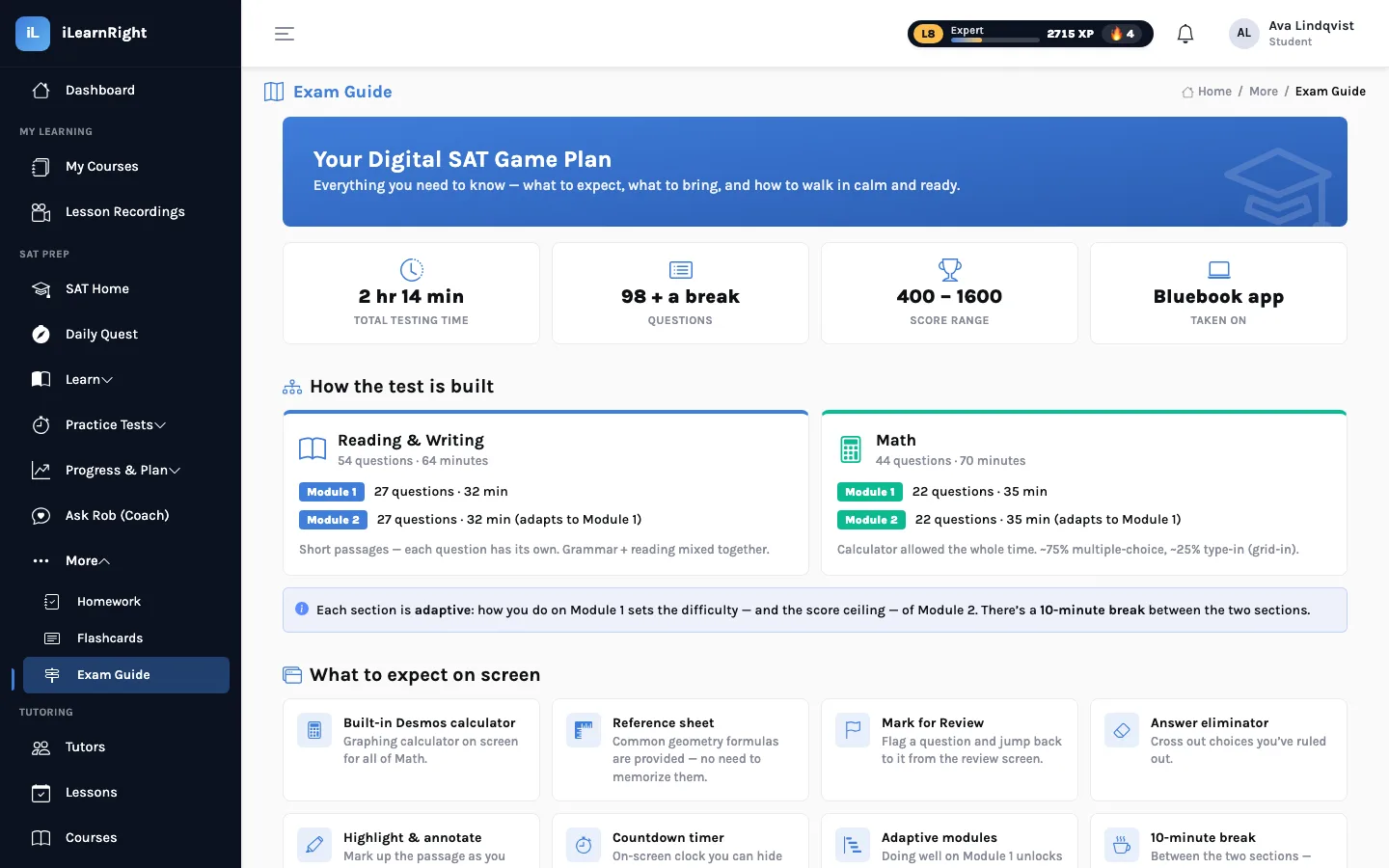
First, know the test
| Reading & Writing | Math | |
|---|---|---|
| Questions | 54, in two modules of 27 | 44, in two modules of 22 |
| Time | 32 minutes per module | 35 minutes per module |
| Format | Short passages, one question each; grammar and reading mixed together | About 75% multiple choice, 25% student-produced answers; calculator allowed throughout |
| Score | 200–800 | 200–800 |
In total that's 98 questions in 2 hours 14 minutes, with a 10-minute break between the sections, for a score from 400 to 1600. The test is taken in the College Board's Bluebook app, with a built-in Desmos graphing calculator and a reference sheet of formulas. Each section is adaptive by module: how you do on the first module sets the difficulty of the second. The Exam Guide in iLearnRight covers all of this in one page, including what to expect on screen and on the day.
Check the official details. Test format, timing, dates and policies are set by the College Board and can change. Confirm them on the College Board's SAT site before you plan around them.
The plan at a glance
Week 1: find your level
- Take the diagnostic: the 16-question quick check if you're short of time, the full one if you can spare an hour. It's untimed; don't rush it.
- Set a target score and test date on SAT Home, so the countdown and the weekly plan have something to aim at.
- Skim the Exam Guide and the Tricks & Shortcuts page once, so the format holds no surprises.
Weeks 2–6: build skills
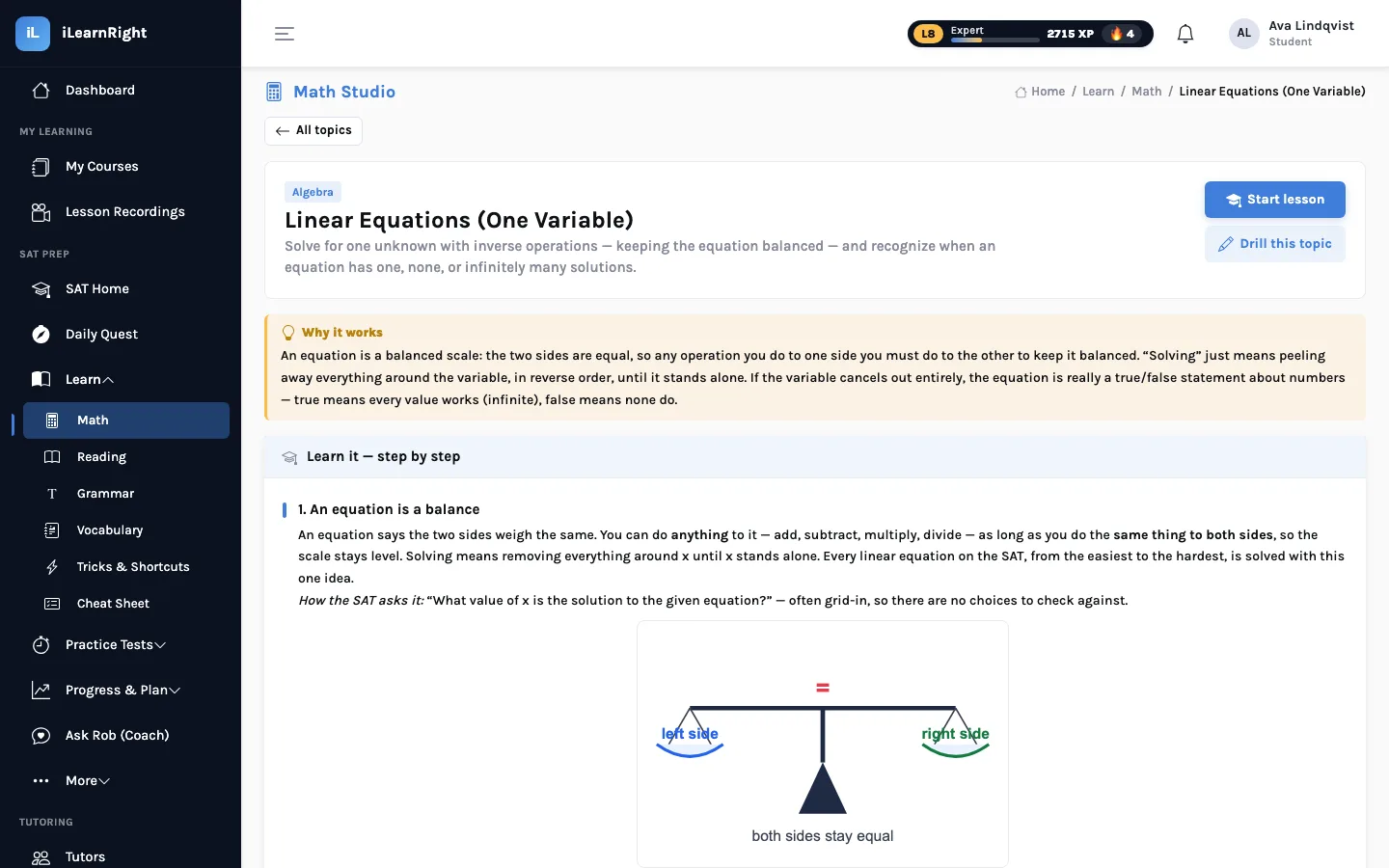
This is the longest phase and the one that moves scores most. Every day, do the daily quest. Two or three times a week, take the 15-minute lesson from the weekly plan, which always targets this week's weakest topics. When a quest keeps missing the same pattern, open that topic in a studio before drilling it again: the studios teach each sub-pattern step by step with a worked example, then let you drill exactly that pattern.
Take a quick mock every second weekend in this phase (weeks 2, 4 and 6). The aim isn't the number; it's to practise the format and give the mastery map more data.
Weeks 7–10: test and target
- Switch to a quick mock every weekend, and one full-length mock in week 9 to practise pacing over the whole 2 hours 14 minutes, break included.
- After every mock, open the results and the Weak Areas page. Spend the week's lessons on the two or three weakest patterns, not on everything you missed.
- If a pattern stays weak for three weeks, it's a good moment to book an hour with a human tutor and bring the pattern with you.
- If you take an official practice test in Bluebook, log it with Log & Review a Real Test so it joins your score trend.
Weeks 11–12: sharpen
- One last full-length mock early in week 11, at the same time of day as your real test.
- Keep the daily quest going, but shorter is fine. Spaced review brings back what you've learned at the right intervals.
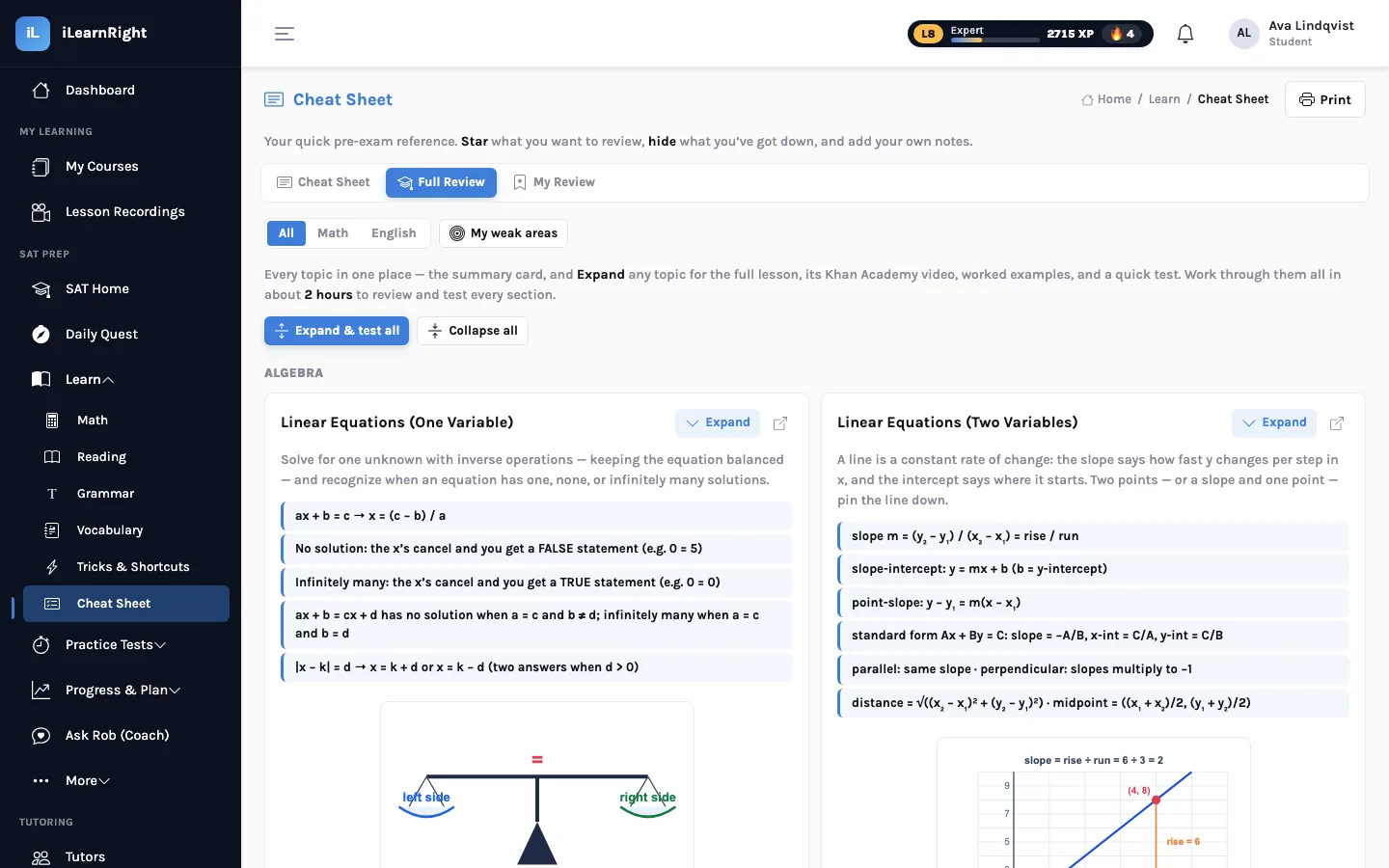
- Work through the Cheat Sheet: a summary card for every topic, with a full-review mode, a filter for your weak areas, and your own notes. Star what you want to review and hide what you've got.
- In the last two days, review rather than learn: re-read the Exam Guide's test-day section and get a good night's sleep.
Ava's twelve weeks, on a busy schedule
Ava has swim practice three evenings a week, so her plan is lighter on weekdays: the quest every day (20 minutes), lessons on her two free evenings, and mocks on Saturday mornings. She's three weeks in with 79 days to go, so a little extra runway. Her quick-mock trend is moving up and her Weak Areas page has narrowed to two patterns, so the next fortnight is about those two, with a tutor session pencilled in if they're still weak after that.
If you have less time
| Runway | What to keep |
|---|---|
| 8 weeks | Week 1 as above, weeks 2–4 building skills, weeks 5–7 testing, week 8 sharpening. |
| 4 weeks | Diagnostic on day one, then daily quests and weak-area lessons, a quick mock each weekend, and one full-length mock in week 3. |
| 2 weeks | Skip new topics. Quick check, daily quests, one full mock for pacing, the Cheat Sheet and the Exam Guide. |
Related reading: how the daily quest and weekly plan work and what a mock-test estimate means.