Practice tells you what you're learning; a test tells you where you stand. iLearnRight has three kinds of test, each for a different moment, plus a way to bring in the result of a real practice test from the College Board's Bluebook app.
1. The diagnostic: where do you stand?
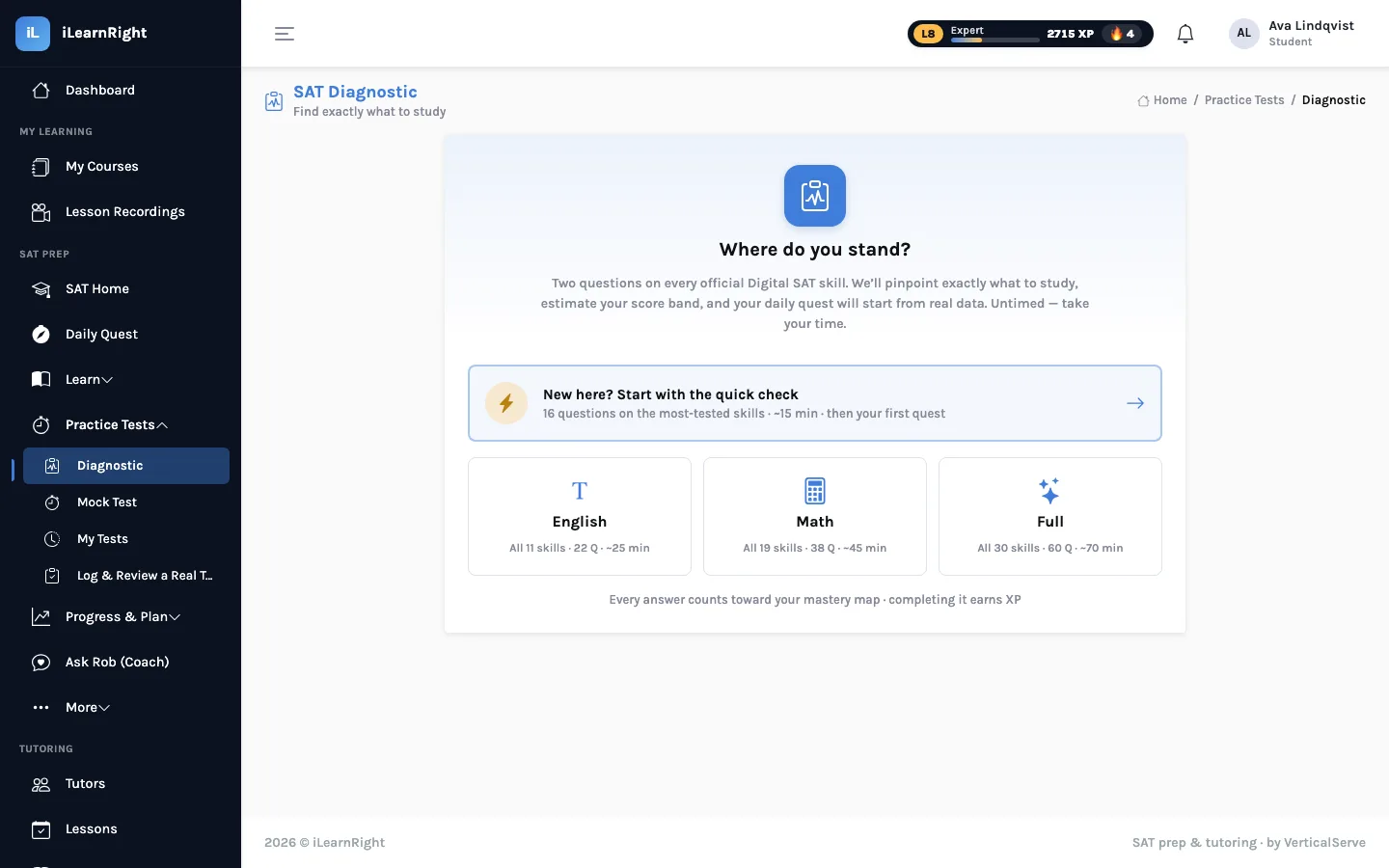
The diagnostic is untimed. The quick check is 16 questions on the most-tested skills (about 15 minutes); the full versions ask two questions on every skill, for English (11 skills, 22 questions), Math (19 skills, 38 questions) or both (30 skills, 60 questions). Each question is drawn fresh from the bank, preferring ones the student hasn't seen in an earlier diagnostic, and every answer feeds the mastery map, so the first daily quest already targets real weak spots.
2. The mock test: Bluebook-style and module-adaptive
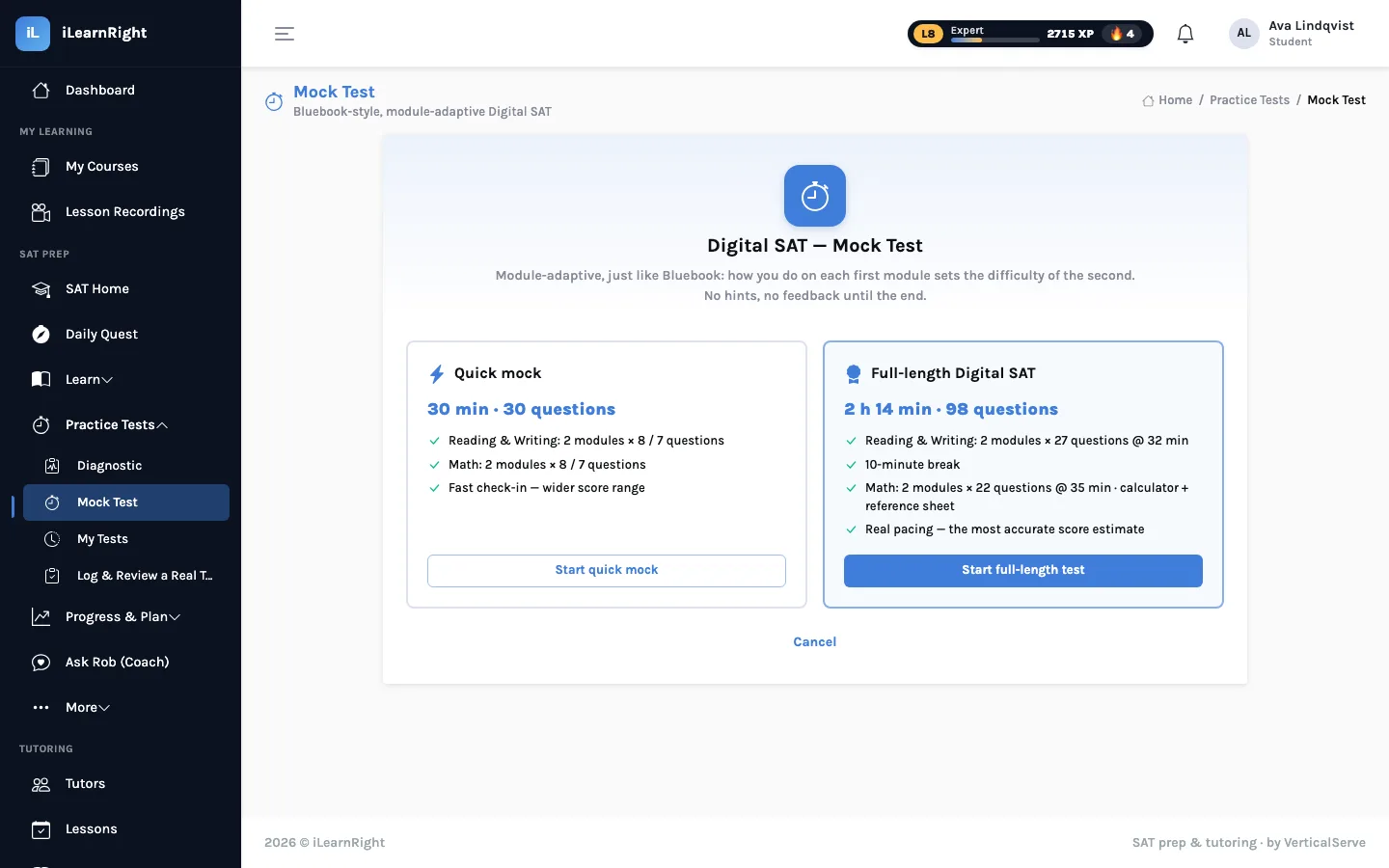
The Digital SAT is adaptive by module. Each section has two modules; how a student does on the first sets the difficulty of the second. iLearnRight's mock follows the same shape:
- Quick mock: 30 questions in about 30 minutes (each section is a module of 8 questions, then a module of 7). Fast, with a wider score range.
- Full-length: 98 questions in 2 hours 14 minutes: Reading & Writing 2 × 27 at 32 minutes each, a 10-minute break, then Math 2 × 22 at 35 minutes each, with the calculator and reference sheet available.
Inside a module the timer is strict and submits automatically at zero. There's a question navigator, mark-for-review, cross-outs that stay with each question, grid-in boxes, and the same keyboard shortcuts as practice. No hints and no feedback until the end, as on the real test.
How the estimate is worked out
After module 1, a student with 60% or more correct goes to the harder module 2; below that, to the easier one. At the end, each section's estimate depends on the route and on accuracy across the section. On the harder route it's 300 + 500 × accuracy; on the easier route 200 + 450 × accuracy, which tops out near 650, mirroring how the real test caps the score of a student routed to the easier module. Each section is rounded to 10 and shown as a range: ±50 for a quick mock, ±30 for a full-length one. The midpoint is added to the student's score trend on SAT Home.
An estimate, not a score. The College Board scales each real test form with its own conversion. iLearnRight's formula is a deliberately simple approximation for practice, and a 30-question mock in particular has a wide margin. Use the trend across several mocks, not any single number. For official scoring information, see the College Board's SAT pages.
3. Results you can learn from
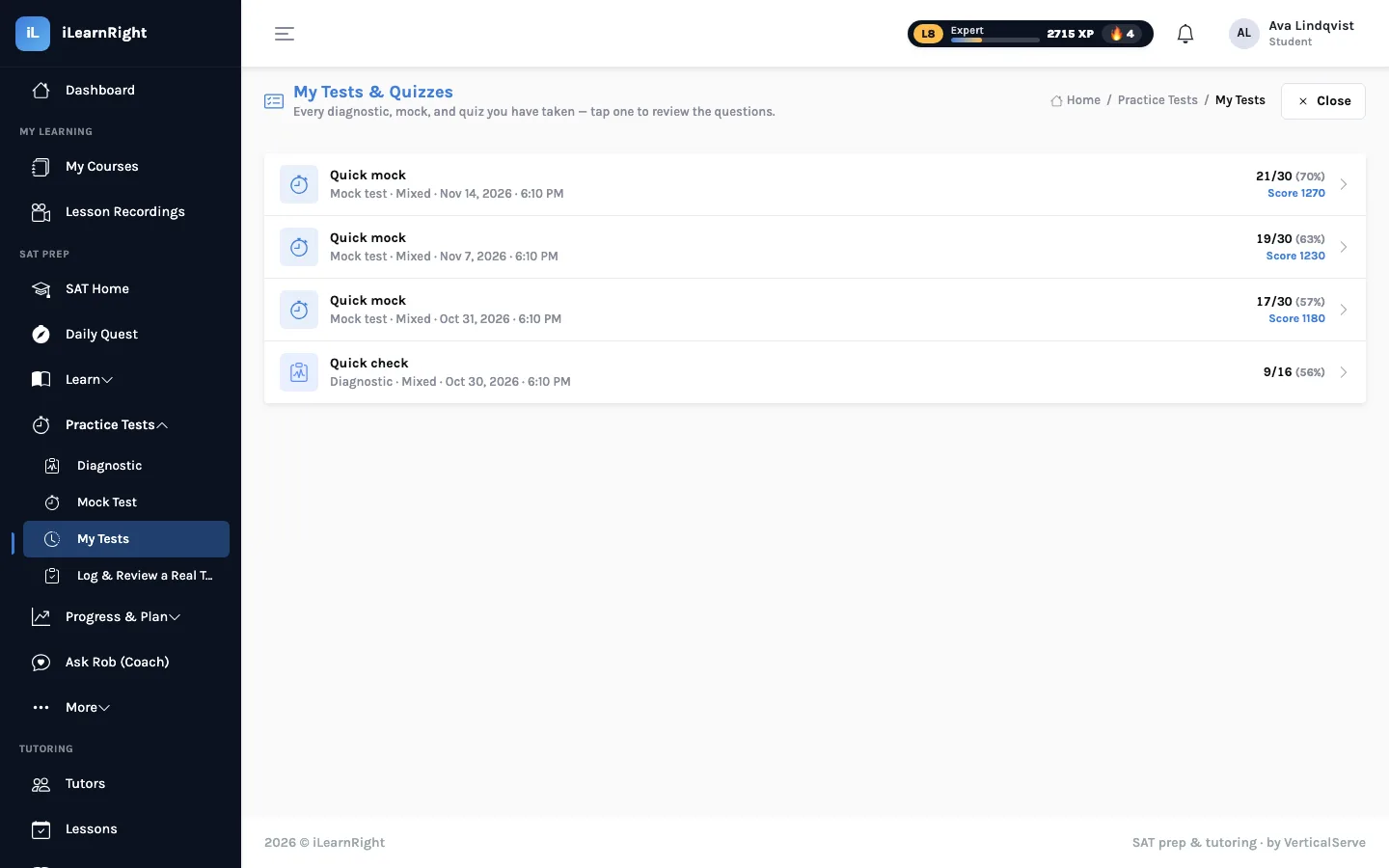
The results page shows the estimated section ranges, accuracy and pacing, whether the student reached the harder module, the skills to focus on (each with a link to drill it), and a per-question review that can be filtered to the questions missed. Every test, diagnostic and quiz is saved in My Tests, so it can be reopened later question by question.
Bringing in a real practice test
Students who take full practice tests in the Bluebook app can log them too. Log & Review a Real Test takes the two section scores (typed in, or read from a score-report upload), asks which modules felt weakest, and adds the score to the trend marked as a Bluebook test. Students can also add wrong questions from a real test to the Test Review page, where the coach explains each one and writes an original look-alike question to practise on; that part uses AI and works where it's configured.
Reading Ava's trend
Ava took a quick mock most Saturdays: about 1180, then 1230, then 1270. Each was a range of roughly ±100 overall, so no single result meant much on its own. Together they point the same way, and her mastery map agrees: Algebra is solid, while percentages and punctuation are where the next points are. Her plan for the next month is one full-length mock to check pacing over the full 2 hours 14 minutes, with quick mocks in between.
When to use which
| Moment | Use |
|---|---|
| Day one, or after a long break | Quick check diagnostic |
| Weekly checkpoint | Quick mock (about 30 minutes) |
| Every few weeks, and in the final month | Full-length mock, for pacing and stamina |
| After an official Bluebook practice test | Log & Review a Real Test |
For how tests fit into the months before test day, see a 12-week Digital SAT study plan.