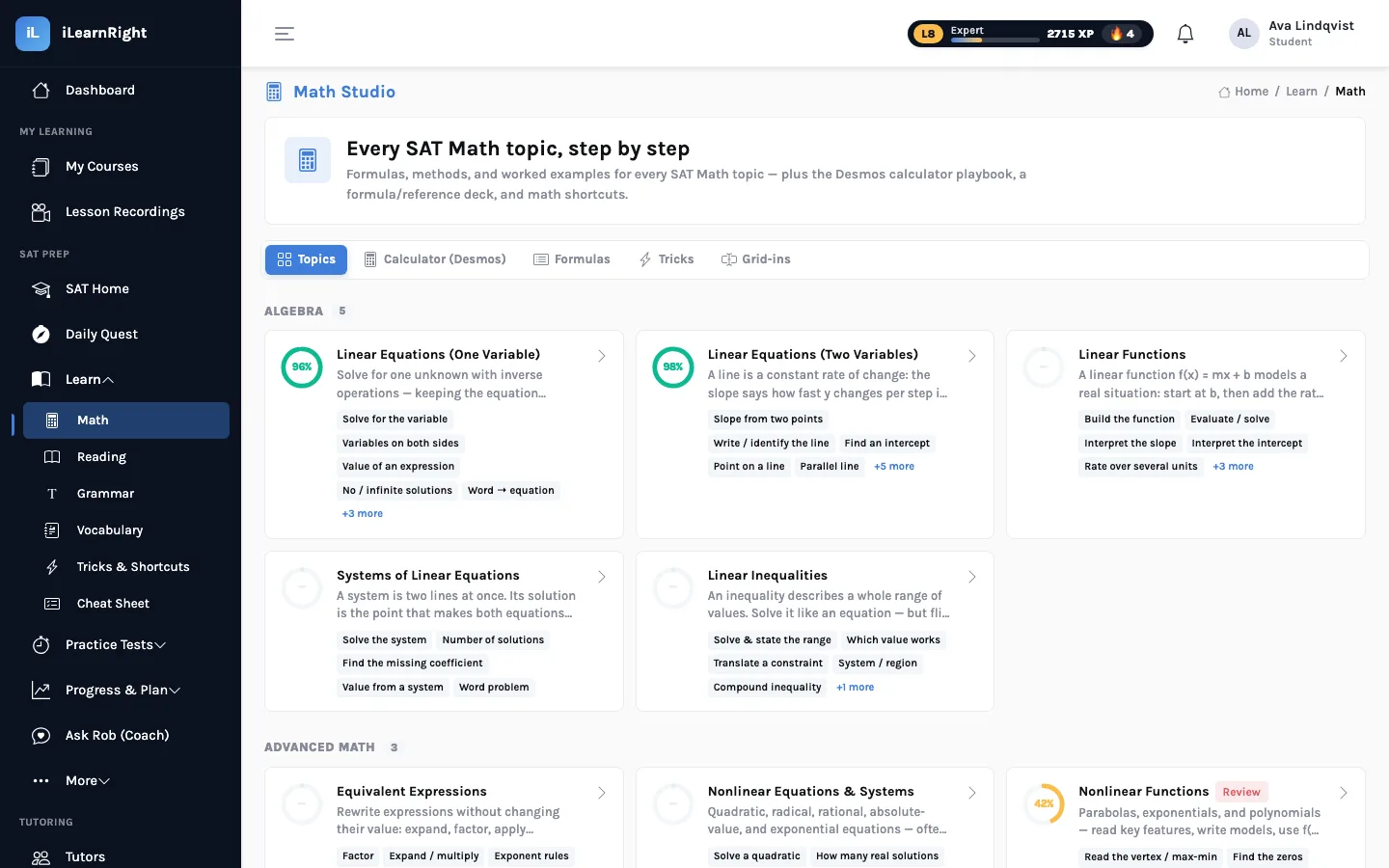
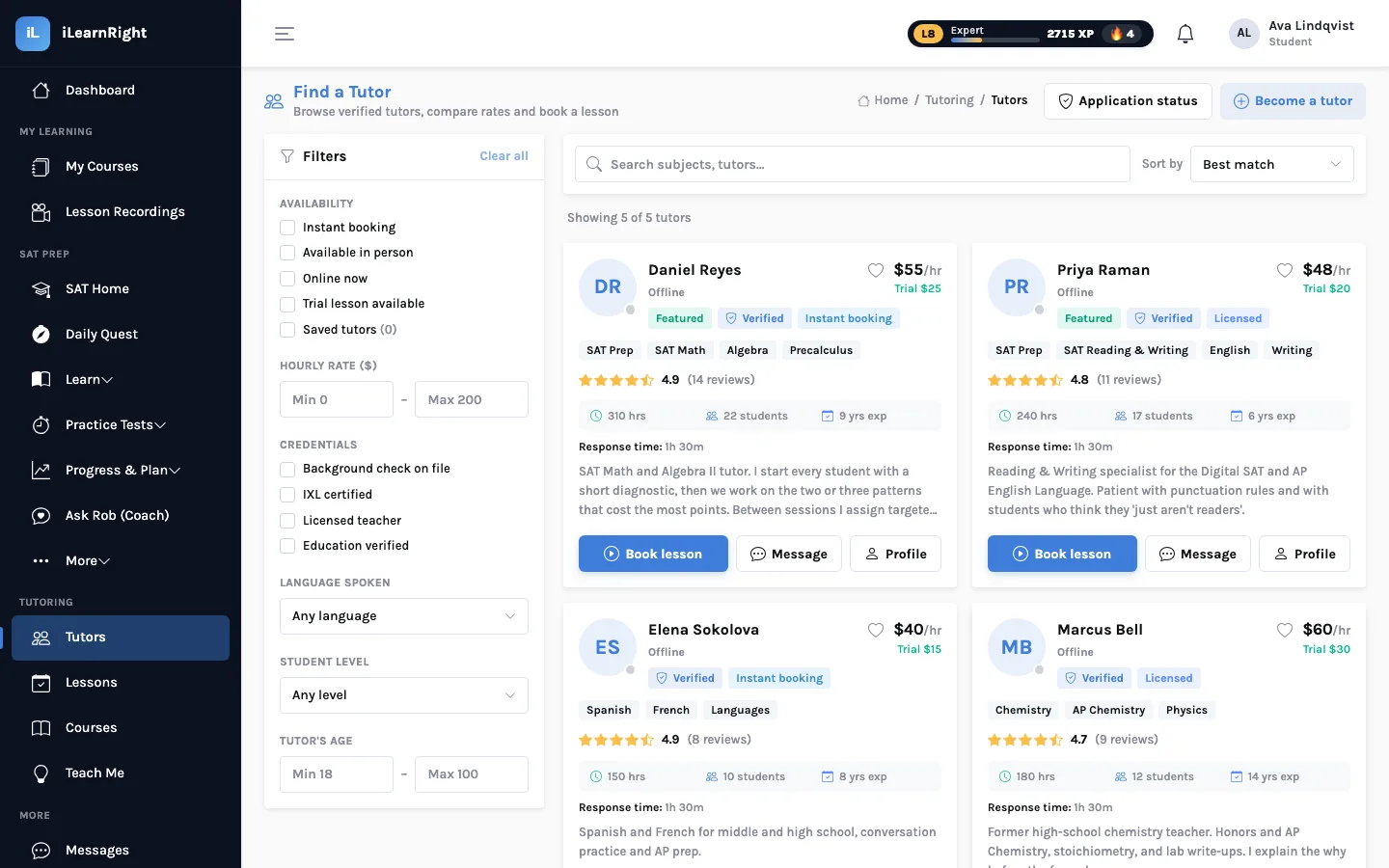
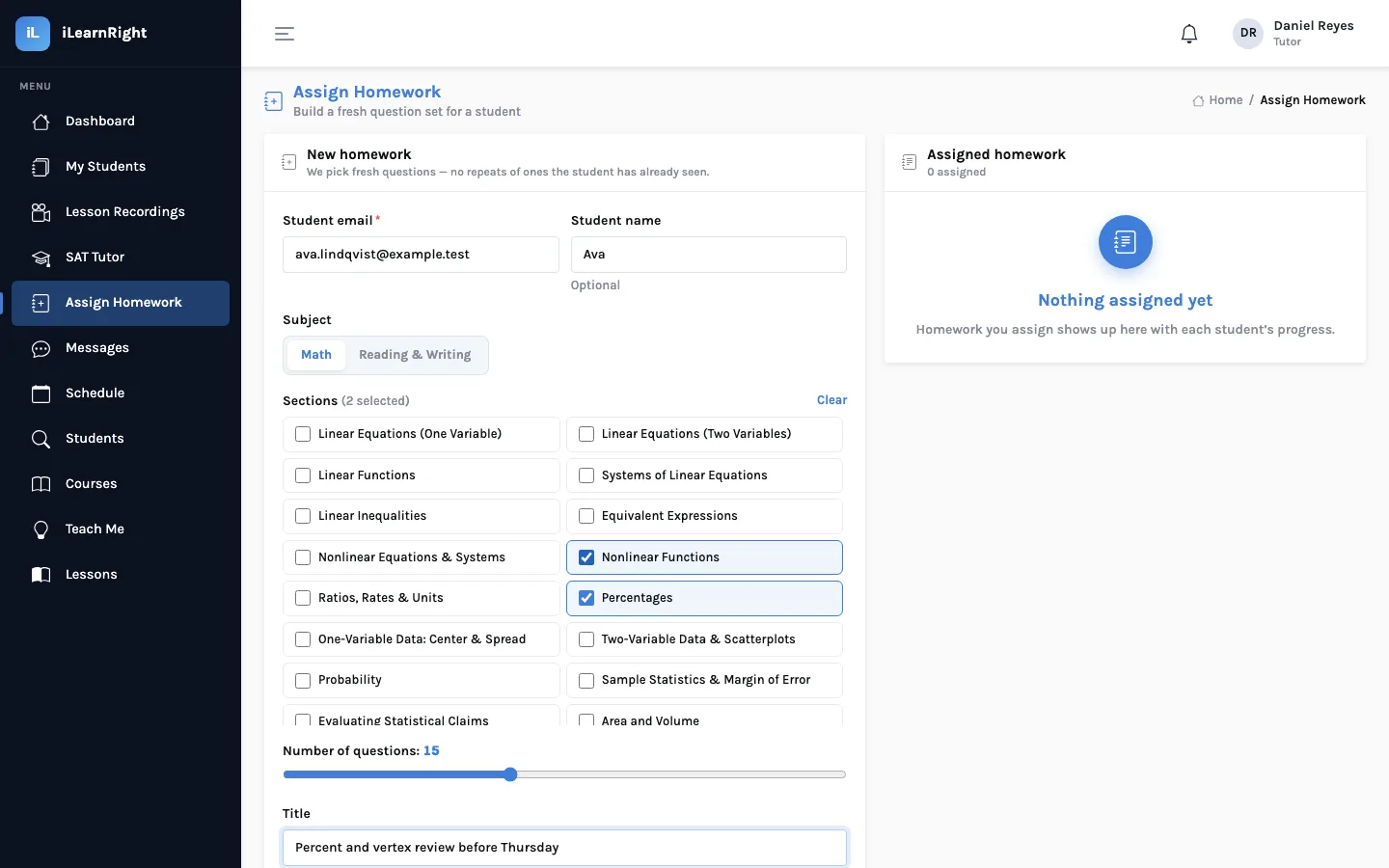
The hardest part of SAT prep usually isn't any one topic. It's showing up four or five days a week for two or three months, and spending that time on the right things. iLearnRight's answer is a small, fixed daily habit: the Daily Quest. This post explains how a quest is chosen, how XP and streaks work, and how the weekly plan builds around it.
What a quest is
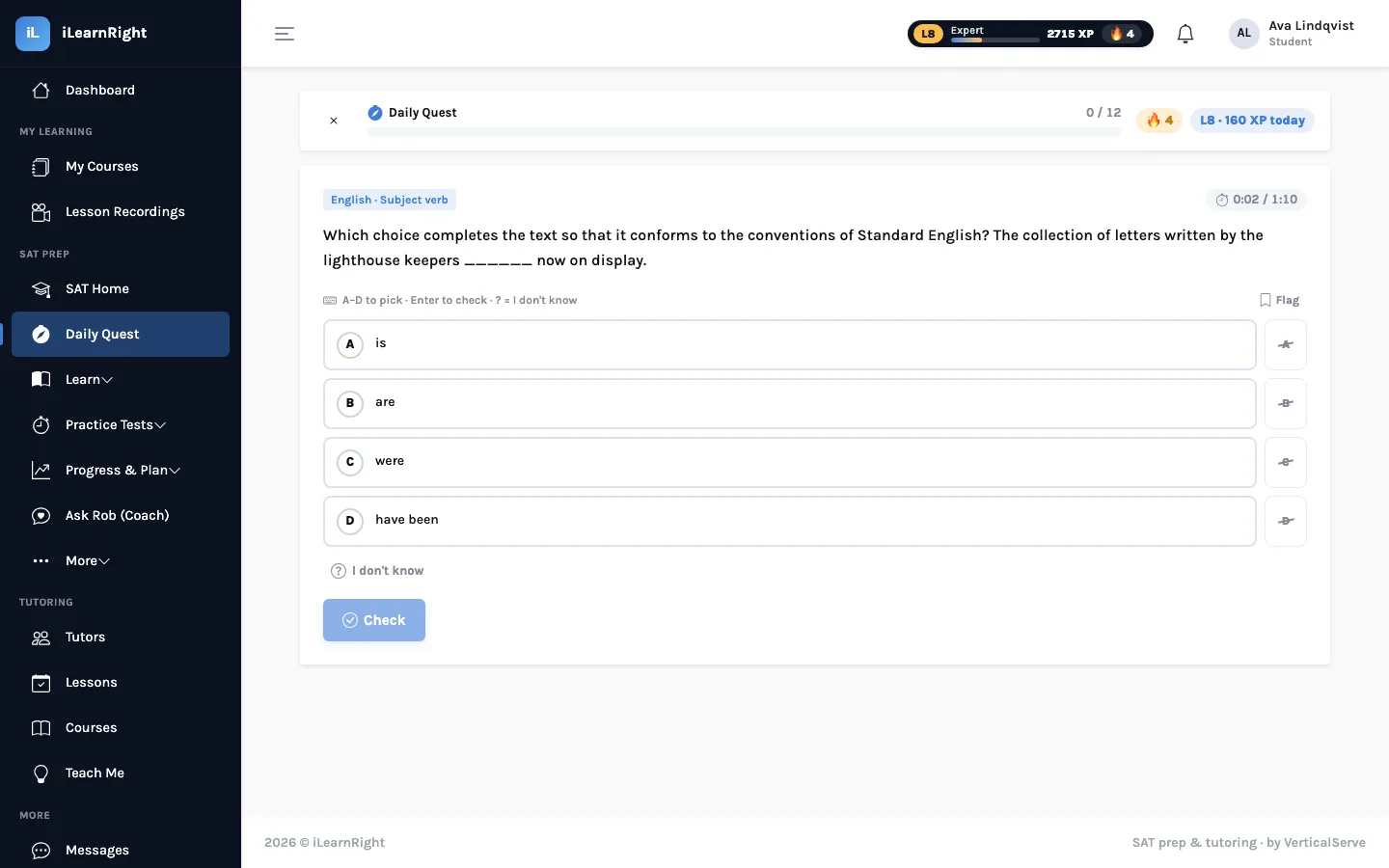
A quest is about 12 questions on three patterns, roughly 20 minutes. The SAT Home page leads with it, and the quest player keeps to one question at a time: pick with A–D, press Enter to check, read the explanation, move on. When the quest is done the day counts toward the student's streak, and a bonus round is offered for anyone who wants more.
How the three targets are chosen
The quest isn't random. iLearnRight gathers candidate patterns in priority order and then alternates subjects, so a quest mixes Math and Reading & Writing instead of being three of a kind:
- Due for review. Patterns whose spaced-review date has arrived, oldest first (mastered patterns are skipped).
- Weakest patterns. Anything the student has tried that's still under 60% mastery.
- This week's focus. The weakest skills in each subject, chosen once a week.
- Any active skill, so a brand-new student still gets a full quest.
For a new student with no history, the quest falls through to steps 3 and 4. That's why the diagnostic is worth doing first: it gives the quest real weak spots to work on from day one.
XP: rewarding honest work
| What happened | XP |
|---|---|
| Clean correct answer (no hints, in time) | 10 easy · 15 medium · 20 hard |
| Correct with a hint | 5 |
| Wrong, "I don't know", or correct only after viewing the solution | 0 |
| Finishing the daily quest | 50 |
| Mastering a pattern (solid, and clean on two different days) | 40, once |
| Streak milestones: 3, 7, 14, 30, 60 and 100 days | 25 to 1,000, once each |
XP only counts on the first attempt at a question within a day, so answering the same item again and again earns nothing. Levels follow a gentle curve (level 2 at 50 XP, level 5 at 800, level 10 at 4,050) with titles from Rookie to Legend, and there are 13 badges for quests, streaks, mastered patterns, mock tests and XP.
Streaks and freezes
A streak day is a day the quest was completed. Missing a day doesn't have to break it: every student starts with two streak freezes, earns another for every seven days in a row (up to three), and a freeze is used up automatically for each missed day. Miss more days than you have freezes and the streak starts again at one. The best streak is kept either way.
For parents: a streak is a nudge, not the goal. A short, honest quest most days is worth more than a long session once a week, and the "I don't know" button is there so students don't guess just to keep their numbers up.
The weekly plan
The Weekly Plan lays the week out as days. Every day has the quest. Most weekdays also have an optional 15-minute lesson on one of this week's weak topics, one concept at a time. Saturday suggests a mock test (quick, about 30 minutes, or full length) as the weekly checkpoint, and Sunday a short re-test of the week's focus topics so the student can see what moved. The page also counts down to the test date and shows how far the mock score has moved since the first one.
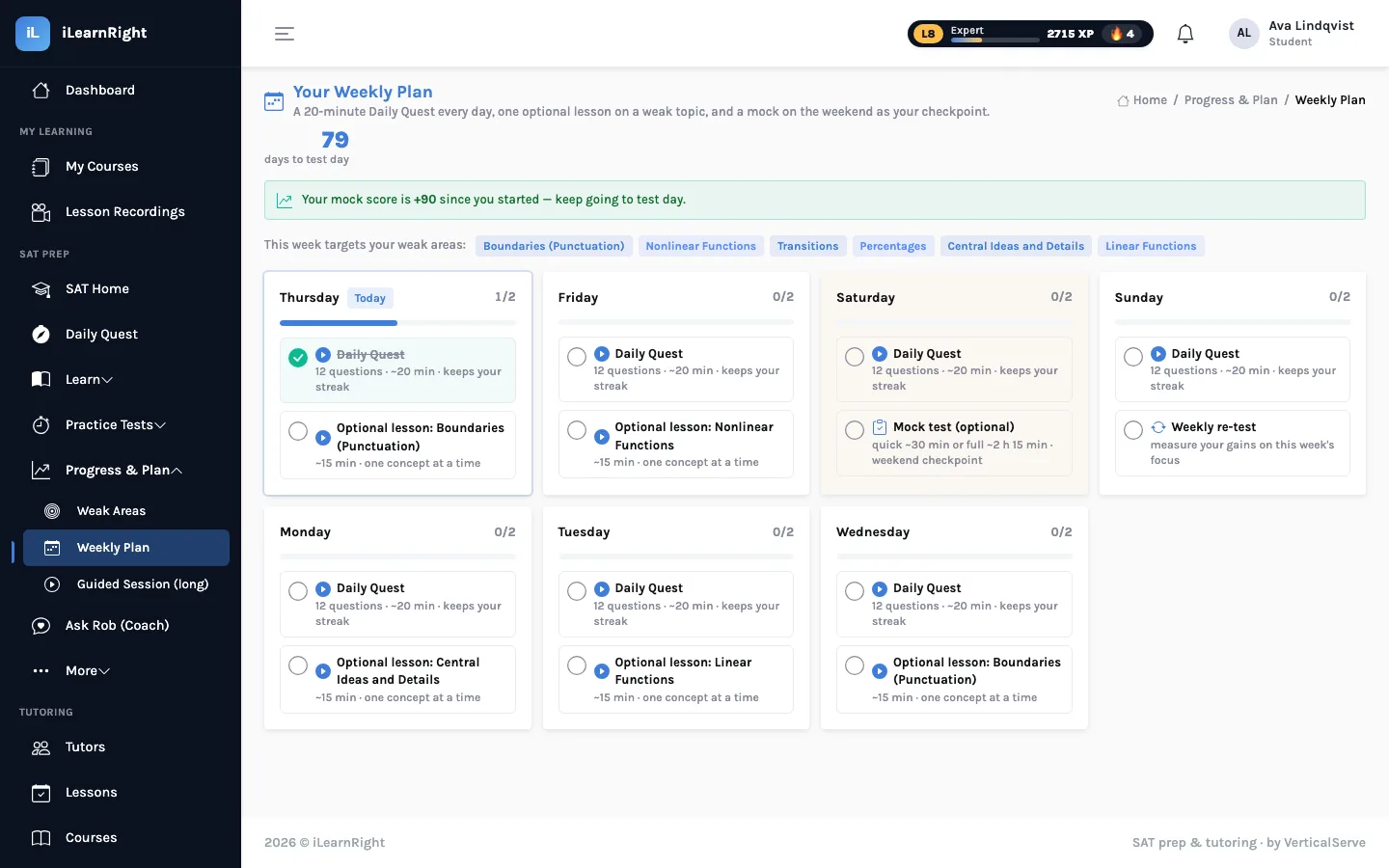
The week's focus is picked on Monday from the weakest skills in each subject, but each day's lessons are re-ranked by current mastery, so a topic that improved on Tuesday drops down the list on Wednesday.
A realistic week for Ava
Ava has swim practice three evenings a week. She does the quest every day before dinner (about 20 minutes), takes the optional punctuation lesson on the two free weekdays, and skips Friday entirely, which uses one of her two freezes. On Saturday she takes the quick mock. Her streak survives, her two weakest patterns got a lesson each, and the mock gives the week a checkpoint score range.