An hour with a good tutor can save you ten hours of going in circles. It can also be an expensive way to be told things you could have read. The question is not which is better; it is which problem you have.
Three signs self-study is enough
- You know what you do not know. Your practice shows clear weak topics, and when you read the lesson for one, it makes sense.
- You keep to a routine. You study most days without anyone checking.
- Your mistakes are slips, not confusions. You misread the question or dropped a sign. More careful practice fixes that; a person explaining it again does not.
Five signs you need a person
- You are stuck on the same idea after three attempts. You have read the lesson, watched a video and tried the questions, and it still does not click. Someone needs to find the wrong assumption underneath.
- You cannot tell why you are getting questions wrong. The worked solution makes sense, and then you miss the next one anyway.
- You do not turn up. A booked lesson is a deadline. For some people that is most of the value, and there is no shame in it.
- The stakes are close. With three weeks until a test, a person can triage faster than you can.
- You need feedback on your own work. Writing, free-response answers and code are judged, not marked. A tutor can say what a marker or a reviewer would say.
A middle path: study on your own and book one lesson when you hit a wall. Bring the specific questions you missed. One focused hour often does more than a weekly slot you have not prepared for.
How to make a lesson count
- Arrive with evidence. A list of the questions you missed, or your working on paper, is worth more than "I don't get calculus".
- Ask the tutor to watch you work. Being shown the method again is rarely the problem. Having someone see where your version goes wrong is.
- Leave with something to do. A short set of questions on the same idea, done within two days.
- Review the wrap-up. If your tutor writes one, read it before the next session, not during it.
How this works on iLearnRight
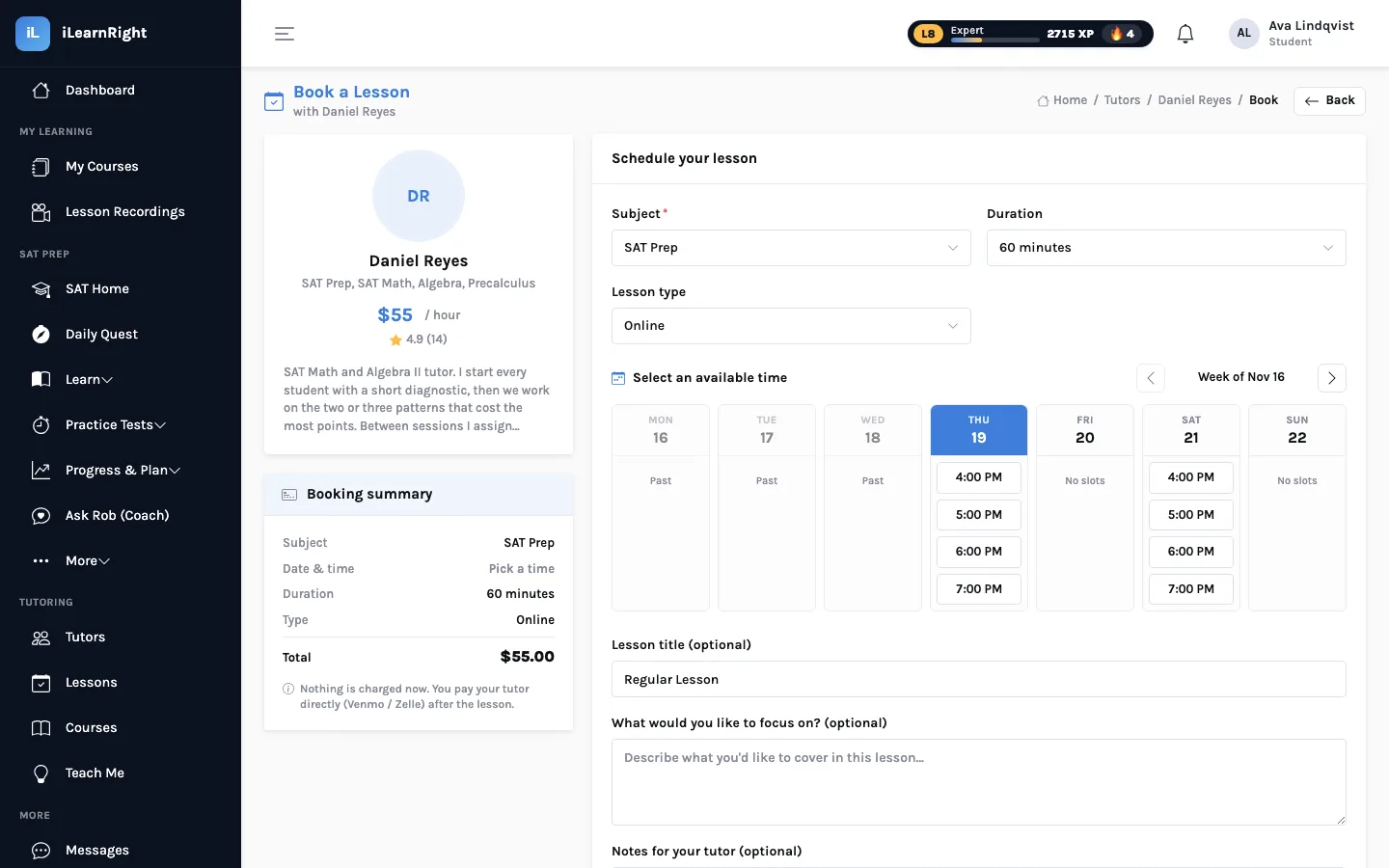
You can use a course entirely on your own: lessons, practice that follows what you miss, flashcards, and an AI coach for questions. When you want a person, Find a Tutor lists approved tutors with their subjects, experience, hourly rate and reviews. You book from their open times and meet in a classroom in the browser with video, screen sharing, a whiteboard and a code pad.
On school courses there is a weekly cycle if you want one: you say what you need, the tutor plans the lesson from your practice data, and writes a wrap-up afterwards with what to practise next.
Three things to know before you book. Tutors are reviewed and approved by our team, but iLearnRight does not run independent background checks. You pay the tutor directly after each lesson, at the rate on their profile. And which subjects have tutors depends on who has joined; today that is mostly test prep and school subjects, and we are looking for data engineering practitioners.
What to ask after the first lesson
Not “was it good?” but “what did you work on, and what are you doing before the next one?”. If your student can answer both, the lesson had a point. A parent linked to the student account can also see lessons and progress in the app.
If you are a working professional
The same test applies. If you are learning a platform for work and the documentation makes sense when you read it, self-study with practice questions is usually enough. Consider a mentor when you need a review of something you built, or when you have an interview or an exam close and want someone to find the gaps quickly.